BPT Program Learning Outcomes
Bachelor of Physiotherapy (BPT)
SRIMS College of Physiotherapy
Affiliated to MUHS, Nashik
-
The BPT program at SRIMS is designed to develop physiotherapists who
are clinically competent, ethically sound, and socially responsible.
On successful completion of the program, graduates will demonstrate
the following outcomes:
Subdomain A – Foundational and Applied Medical Sciences
-
Demonstrate comprehensive knowledge of human anatomy,
physiology, biochemistry, pathology, microbiology,
pharmacology, and related medical sciences to understand
health, disease, and dysfunction in a physiotherapeutic
context.
-
Understand the structure and function of the human body and
its responses to internal and external stressors, forming a
base for clinical reasoning.
Subdomain B – Physiotherapy Sciences
-
Acquire in-depth knowledge of physiotherapy principles,
including biomechanics, kinesiology, exercise therapy,
electrotherapy, and movement sciences.
-
Integrate physiotherapeutic knowledge across specialties to
assess, plan, and deliver appropriate interventions.
Subdomain A – Clinical and Functional Assessment Skills
-
Conduct holistic patient assessments using standardized
tools and clinical reasoning to identify impairments,
functional limitations, and participation restrictions.
Subdomain B – Treatment Planning and Implementation
-
Develop and execute individualized treatment plans based on
evidence-based practices in physiotherapy.
-
Apply therapeutic techniques and modalities safely and
effectively across age groups and clinical conditions.
Subdomain C – Documentation and Reporting
-
Maintain accurate, ethical, and legally compliant patient
records, progress notes, and discharge summaries using
appropriate formats.
Subdomain A – Professionalism and Ethics
-
Exhibit integrity, empathy, and professionalism in all
patient and institutional interactions.
-
Adhere to ethical codes and medico-legal standards while
delivering care.
Subdomain B – Communication Skills
-
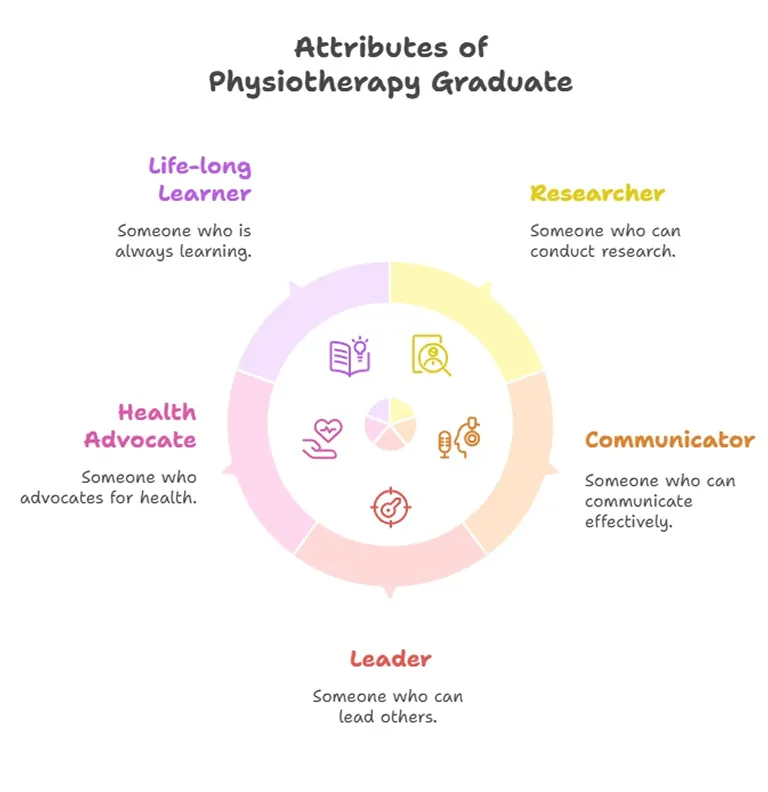
Display effective interpersonal and communication skills
with patients, families, healthcare professionals, and the
community.
-
Promote patient education and awareness through clear,
compassionate dialogue.
Subdomain A – Research and Scientific Inquiry
-
Understand the basics of research methodology, epidemiology,
and biostatistics.
-
Critically analyze scientific literature and apply research
findings to clinical decision-making and patient care.
Subdomain B – Lifelong Learning and Continuing Professional
Development
-
Engage in reflective practice and continuous education to
stay current with evolving knowledge, technologies, and best
practices in physiotherapy.
Subdomain A – Health Promotion and Disease Prevention
-
Plan and participate in community-based rehabilitation,
health awareness, and prevention programs tailored to
diverse population needs.
-
Advocate for accessible physiotherapy services and equitable
healthcare.
Subdomain B – Societal and Cultural Sensitivity
-
Demonstrate an understanding of socio-economic, cultural,
and environmental factors affecting health and
rehabilitation, particularly in underprivileged and rural
communities.

 Plastic Book Bags
1 ×
$940.00
Plastic Book Bags
1 ×
$940.00
 The Genie Mind
1 ×
$899.00
The Genie Mind
1 ×
$899.00
 The Energy Book
1 ×
$756.00
The Energy Book
1 ×
$756.00
 Pencil Bag
1 ×
$723.00
Pencil Bag
1 ×
$723.00
 Sharpner
1 ×
$1080.00
Sharpner
1 ×
$1080.00